Current Issue
Vol. 1 No. 1 (2026): Living Fiqh: Journal of Islamic Law in Society
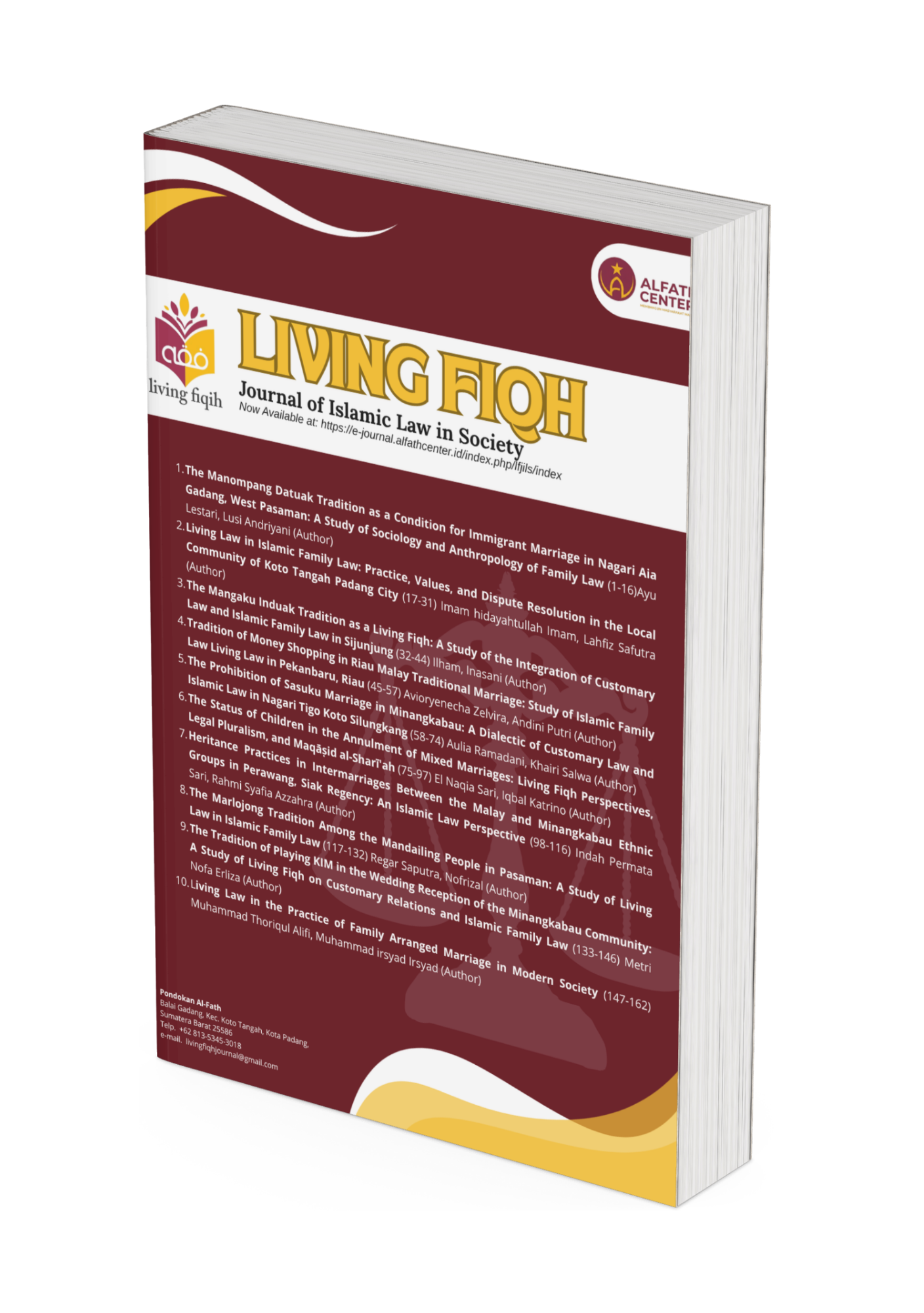
Living Fiqh: Journal of Islamic Law in Society publishes original research articles and conceptual studies on contemporary Islamic law from socio-legal and living law perspectives. This inaugural issue has been available online since June 29th, 2026. All articles in this issue were written or co-written by 19 authors representing 8 affiliations from two countries (Indonesia and Turkey), namely Universitas Islam Negeri Imam Bonjol Padang, Universitas Negeri Padang, Universitas Andalas, Universitas Riau, Institut Agama Islam Negeri Kerinci, Universitas Putra Indonesia YPTK Padang, Universitas Nusantara PGRI Kediri (Indonesia), and the International Fraternity Association (IFA), Istanbul (Turkey). The published articles focus primarily on Islamic family law, living fiqh, legal pluralism, customary law, and the interaction between Islamic law and local socio-cultural traditions in contemporary Muslim societies.
Published:
2026-07-01
Articles
Living Fiqh: Journal of Islamic Law in Society
Journal Initials: LFJILS
e-ISSN: xxxx-xxxx
DOI Prefix: xx.xxxxx by 
Publisher: Al-Fath Center for Research Literacy and Education
Frequency: Biannual (June and December)
Access Model: Open Access Journal
Editor-in-Chief: Dr. Hamda Sulfinadia, M.Ag
Citation Analysis: Google Scholar | Dimensions
Living Fiqh: Journal of Islamic Law in Society is a peer-reviewed journal dedicated to advancing the study of Islamic law through socio-legal, living law, and interdisciplinary perspectives. The journal understands fiqh not merely as a body of normative legal doctrine, but as a dynamic social practice shaped by and responsive to the realities of Muslim societies. It explores the interaction between the normative sources of Islamic law including the Qur'an, Hadith, classical fiqh (turāth), fatwas, and state legislation and contemporary social, cultural, political, economic, technological, and institutional contexts, with the aim of promoting the development of a living fiqh paradigm that responds to legal pluralism, social change, and the pursuit of justice.
The journal welcomes original research articles, empirical studies, socio-legal research, case studies, and conceptual analyses on the practice and development of Islamic law in society. Its scope includes, but is not limited to, Islamic family law, inheritance, zakat, waqf, Islamic finance, religious courts, fatwas and religious authority, legal pluralism, the interaction between Islamic law, customary law, and state law, the sociology and anthropology of Islamic law, maqāṣid al-sharī‘ah, gender, human rights, environmental governance, public policy, and the digital transformation of Islamic law in contemporary societies.